
By Hassan Aaliyah, Maryam Saheed, Oyekanmi Islamiyat Ayomide, Sulyman AWAL IBRAHIM, Abubakar Abdulsamad Ayomide, Chioma Sophia, Adebayo Sultan, Solihu Kausar, Maryam Ayomide AbdulAzeez, Rokibah Opeyemi Ibidokun & Oluwaferanmi Kolade
Nigeria’s inflation rate has moderated, but conversations with traders and consumers in Ilorin reveal a far less straightforward reality, with seasonal foods becoming cheaper in some stalls while other prices remain high, customers reduce what they buy, and traders struggle to protect margins against transport, restocking and spoilage costs.
At the market in Ilorin, Mrs Tawakalitu does not need an inflation index to explain what has happened to the value of money. Her measure is the ₦10,000 she takes shopping and the increasingly limited assortment of food it allows her to bring home.
There was a time, she recalled, when that amount could pay for rice and semovita and still leave enough for other items. Today, she said, a shopper might buy only a few essentials, perhaps garri and beans, before most of the money is exhausted. Getting to and from the market has become more expensive too: journeys she remembered costing between ₦100 and ₦250 can now require ₦300, ₦500 or, depending on the distance, as much as ₦1,000.
Yet a few stalls away, the economic story can look remarkably different. One yam seller at Oja-Oba said three tubers that had sold for about ₦8,000 roughly three months earlier were going for around ₦4,000 at the time of the interview, meaning that ₦10,000 could buy about six tubers instead of roughly three. A pepper seller in the same market described a similar reversal, saying a basket that previously sold for about ₦4,000 had fallen to roughly ₦1,500. Both traders attributed the declines primarily to seasonal availability and increased supply.
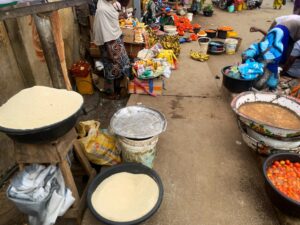
Those contrasting accounts form the most important finding from reporting in Ilorin: there is no single experience of food inflation inside a market. Some prices are falling, others remain stubbornly high, while still others vary according to the period in which a trader bought stock, the quantity being measured, the source of supply and the particular goods a household needs. What appears more consistent across many of the conversations is not that every commodity is becoming more expensive, but that households remain highly sensitive to price and increasingly adjust the quantity or composition of what they buy.
That picture is particularly significant at a time when Nigeria’s national inflation statistics are moving in a direction that might, at first glance, suggest improving conditions. The National Bureau of Statistics puts headline inflation at 15.91 percent, marginally below 15.93 percent previously, while food inflation moved higher to 17.52 percent from 16.96 percent. The country’s Consumer Price Index was rebased with 2024 as its price reference year, a methodological change intended to make the basket better reflect current consumption patterns.
A slower inflation rate, however, does not mean that prices have returned to where they were before the recent cost-of-living shock. It means that prices, across the basket being measured, are rising at a slower rate. That distinction becomes visible inside Oja-Oba, where one trader can report cheaper yam while a shopper still feels that her overall food budget has lost purchasing power.
Mrs Amina, who sells rice, beans, spaghetti, oil, seasoning and other food items around the Oja-Oba area, said a bag of rice was selling for about ₦54,000 when she was interviewed. She recalled a dramatically lower price many years earlier, but because that historical comparison reaches back to the administration of former President Goodluck Jonathan and does not establish an equivalent rice type, weight and precise date, it is more useful as a recollection of how much prices have changed over time than as a like-for-like inflation measurement. What is more immediately relevant is Amina’s observation that customers complain about prices and that she records stronger sales whenever food is cheaper. She attributed much of the pressure she sees in her business to transportation costs, customs duties and government regulations.
Her customer, Mrs Sanni from Olore, expressed the problem from the other side of the transaction. When goods become too expensive, she said, consumers cannot simply obtain everything they want, even as sellers must charge prices that reflect what they themselves paid for stock. The exchange complicates the common assumption that food inflation is simply a contest between traders raising prices and consumers resisting them. In many cases, both sides of the transaction are responding to costs neither completely controls.
The yam trade offers an even clearer example of why a market analysis can become misleading when different voices are forced into one conclusion. While the Oja-Oba seller who linked recent price declines to the rainy season said three tubers had fallen from about ₦8,000 to ₦4,000, another seller, Miss Fathia, reported exactly the opposite experience. She said a tuber that had previously cost between ₦1,500 and ₦2,000 was selling for around ₦4,000, while what she described as a bulk purchase had risen from about ₦80,000 to somewhere between ₦150,000 and ₦200,000. Fathia attributed her experience primarily to the higher cost of buying yam from farmers and transporting it to market, adding that customers continued to buy but increasingly took smaller quantities.
Neither account necessarily cancels out the other. The interviews may have been conducted at different moments in the supply cycle; the tubers may have differed in size or variety; the traders may buy from different producing communities or at different points in the distribution chain. Without standardising those variables, the evidence cannot responsibly support a declaration that yam prices everywhere in Ilorin are either rising or falling. What it does show is a market in which traders can experience substantially different price movements even when selling the same broad commodity.
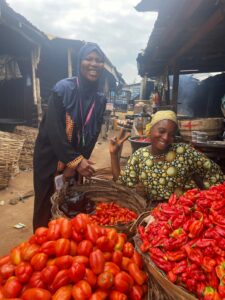
Pepper tells much the same story.
One Oja-Oba trader said increased seasonal availability had brought the price of a basket down from roughly ₦4,000 to ₦1,500 and argued that improving agricultural production would ultimately increase supply. “Once enough farmers are able to harvest, there will be enough,” the trader said.
Mama Tolu, another pepper seller at Oja-Oba in Ilorin, described a markedly different calculation. Her account covered a bag of red pepper rather than the basket measured by the other seller, and she said her buying price had risen from approximately ₦18,000 to ₦35,000 over about two months. Transport for each bag, she reported, increased from around ₦2,000 to ₦3,500, while the cost of baskets and nylon packaging also went up. She associated those increases with diesel costs, poor roads and reduced farm yield during the period.
The two pepper accounts should not be treated as contradictory price quotations for the same unit, because they measure different quantities over different reference periods. They nevertheless illustrate why household experience can diverge sharply from one stall or transaction to another. A seasonal glut can make a particular retail quantity cheaper while another trader, sourcing a different volume or grade and restocking at another point in the supply chain, simultaneously experiences higher procurement costs.
More revealing in Mama Tolu’s account is what happened to her profit. She estimated that she previously made about ₦8,000 on a bag but now makes closer to ₦4,000, even though the prices paid by customers have increased. Her costs, she said, have risen faster than her returns.

