Artificial intelligence is finding its way into marketing, design and online sales among some businesses in the Kwara State capital. But as investment and training expand, a harder question is emerging: is AI making ordinary businesses more productive and profitable?
When Ella needs help finding the right words to market a product, she sometimes turns to ChatGPT. As manager of Veethaluxe Limited in Ilorin, she uses the artificial intelligence tool mainly for social-media captions and occasional questions connected with the business. The attraction is simple: it saves time. What she cannot say with similar confidence is how much money that convenience has made. Asked whether AI had increased revenue, Ella said any benefit was probably indirect and stopped short of identifying the technology as a significant driver of sales.
Her caution captures the tension surrounding Ilorin’s growing encounter with AI. Interviews by Craft Post with entrepreneurs, trainers and business-support organisations found the technology being used for marketing, design inspiration, websites and product promotion. Yet no organisation interviewed could provide a comprehensive figure for the number of SMEs across Ilorin currently using AI, while evidence linking its use to sustained improvements in revenue or productivity remains limited.
At Craft Innovation Hub (CIH), where Mr. Wasiu Oseni serves as Head of Operations, training has emphasised practical application rather than familiarity with AI alone. The hub has organised hands-on prompt-engineering programmes and, in April 2026, partnered with the Kwara State Ministry of Communications on an AI-assisted media workflow programme. The state ministry confirmed that the programme brought together press secretaries and information officers for practical sessions on using AI to improve the speed, clarity and accuracy of public communication.
The issue is increasingly relevant to public policy. Nigeria’s National Artificial Intelligence Strategy identifies economic growth, competitiveness and increased productivity among the country’s objectives for AI, including improving efficiency and innovation across agriculture, manufacturing and services. In Kwara, the state government has also encouraged businesses to take advantage of AI initiatives and facilities at the Ilorin Innovation Hub as part of its wider business and innovation agenda.
From training to everyday use
At the Ilorin Innovation Hub, an official who identified himself as Henry said participation in AI-related programmes had increased, but cautioned against treating everyone attending such programmes as an existing business owner. Some participants come for personal learning while others operate businesses, he said. Asked how many businesses continued using AI after training, Henry acknowledged that the hub did not track every participant, although monitoring was more structured for businesses involved in incubation or acceleration programmes where investments had been made.
Abdulbasit, a digital and AI skills trainer interviewed at the hub, was equally cautious. “I can’t really say because there is no data to back up my say,” he said when asked how many Ilorin businesses were actually using AI. He had nevertheless seen business-owning students use the AI-assisted platform Lovable to develop websites where vendors could display products and prices. In his view, limited understanding of what AI could do remained a barrier for some businesses.
Among entrepreneurs, the depth of adoption varies. At 360 Printing Press, graphic designer Abubakar Faizol uses AI mainly for inspiration and occasionally for graphic design, seeing it as an aid rather than a substitute for professional judgement. “AI is good but can’t replace a human thinker,” he said.
Ella identified trust as another obstacle. She said some entrepreneurs were suspicious of AI because they did not understand how the applications worked and feared that using them could expose information on their devices or create opportunities for fraud. Her own experience has been more positive, but even as a user she distinguishes between a tool being useful and being able to prove that it has increased revenue.
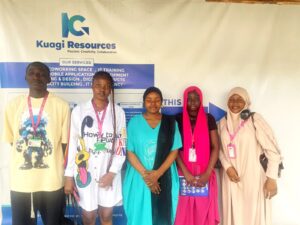
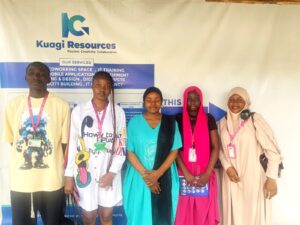
At Kuargi Resources, founder and Chief Servant Mrs Memunat Uthman said the organisation focuses particularly on helping traditional SMEs digitalise their operations and follows participants after workshops. She estimated that roughly 250 businesses had been exposed to AI and other digital tools through its programmes, many of them existing enterprises rather than technology startups.
Based on Kuargi’s internal follow-up, Uthman estimated that about 57 per cent of participants had adopted AI in some form. Food, fashion, jewellery and other lifestyle businesses were among those using the tools more readily, particularly for marketing. She cited Humi Home of Snacks as one example, saying AI had been used in promotional design and marketing. She also acknowledged that some entrepreneurs who understand AI still struggle to use particular tools confidently.
Kuargi also estimated that 43 per cent of businesses it assessed had reported increased revenue after adopting AI. The figure, however, remains an internal programme assessment. The interview did not establish the survey sample behind the percentage, the period over which revenue was compared or how other factors affecting sales were considered. It therefore cannot be treated as evidence of the experience of Ilorin businesses generally.
Measuring what really changes
The wider business environment complicates the picture. Engr. Abu Salami, FNSE, President of the Kwara Chamber of Commerce, Industry, Mines and Agriculture, described the chamber’s role in promoting businesses, providing training and engaging government over conditions affecting private enterprise. Roads, electricity and water supply were among the challenges identified during the interview. A Kwara State Government report on the chamber’s August 2026 annual meeting also identifies Salami as KWACCIMA President and records the chamber’s continued advocacy for policies that improve investment and the ease of doing business.
Those pressures matter because adopting an AI tool is only one part of running a business. For programmes aimed at SMEs, a stronger measure of success would go beyond attendance to establish whether participants continue using AI after training, which business processes have changed and whether time, costs, customer reach or revenue have improved. Nigeria’s AI strategy similarly links successful adoption to productivity, skills and the wider conditions required to translate technological potential into economic value.
Craft Post could not establish a citywide figure for AI adoption among small businesses from the institutions interviewed. A government ministry approached for business-monitoring information said it was not the agency responsible for the data sought, while a visit to Malhub Innovation Hub did not yield an interview because the relevant team was unavailable. The reporting therefore provides a picture of selected businesses and support organisations rather than a statistical portrait of every SME in Ilorin.
What emerges is an uneven, early-stage pattern. Some entrepreneurs have found practical uses for AI in marketing, design and online presentation, while some training organisations are beginning to follow participants beyond the classroom. At the same time, limited knowledge, scepticism and weak impact data make it difficult to determine how deeply AI has entered everyday business operations.
Ella’s experience at Veethaluxe leaves that question unresolved. ChatGPT helps her produce marketing content more quickly, and that usefulness is clear. But ask how much additional revenue the technology has generated, and certainty disappears. For now, she can put a value on the time AI saves more easily than she can put a figure on the money it makes.
Oluwaferanmi, Sophia, Ayomide and Kausar are with Craft Post, a publication of Craft Innovation Hub.